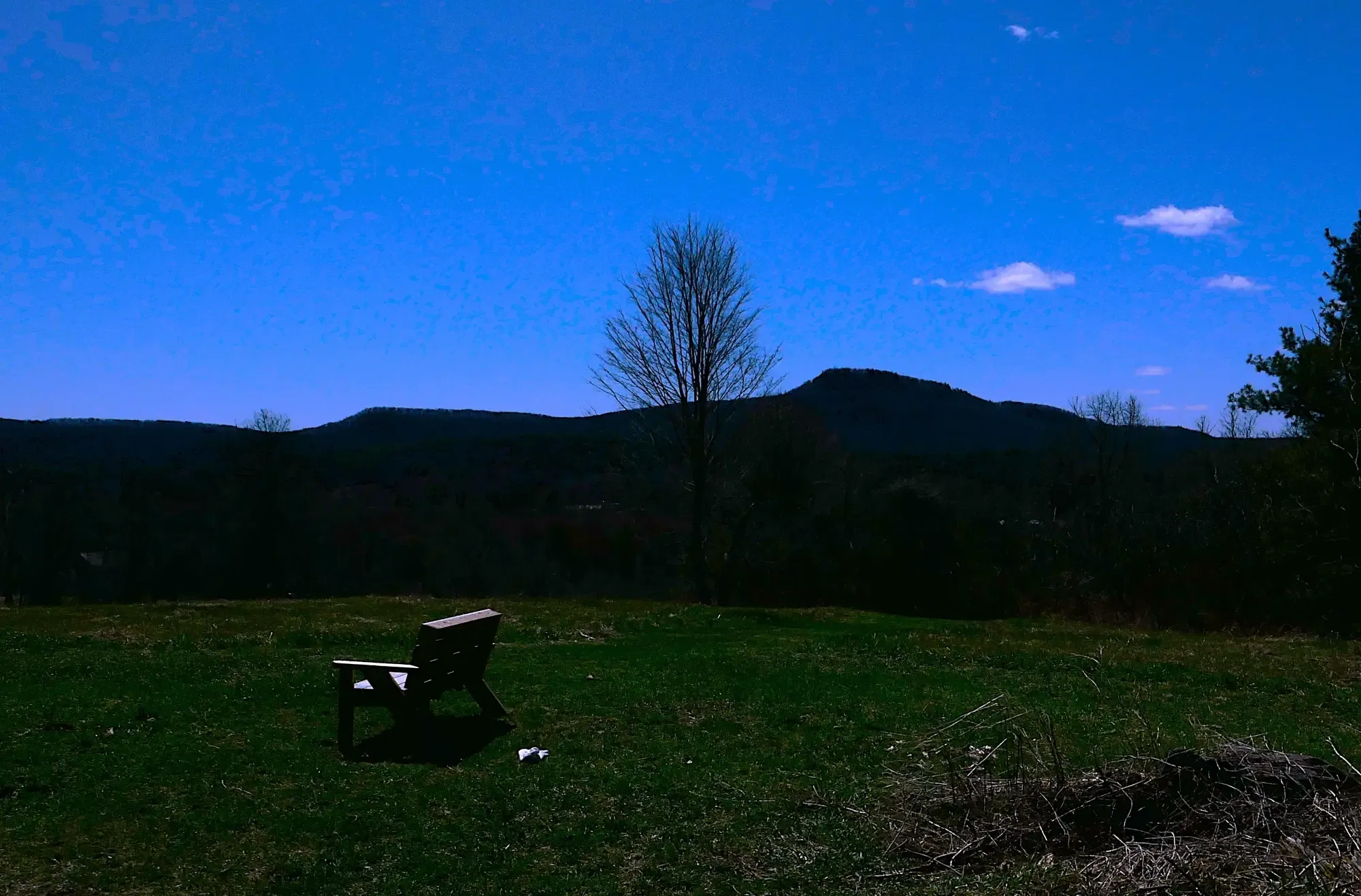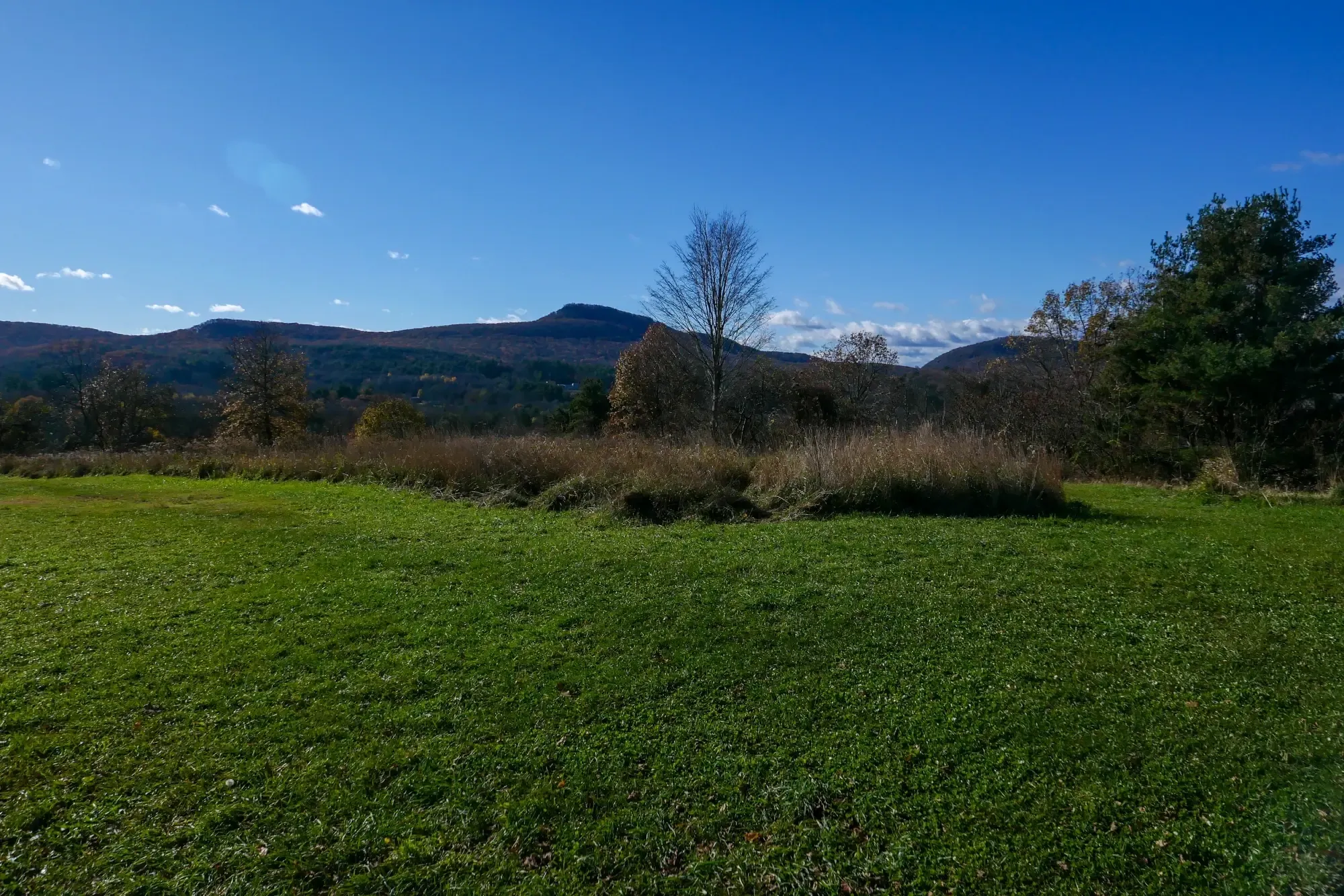
Looking southward, the 10-mile-long east-west Holyoke Range is at its closest only 1 mile from Mt. Pollux. The landform composed of various distinct peaks up to 1,100 feet in elevation was formed ca. 200 Ma during the late Triassic and early Jurassic periods. The fault-block range is part of the 100-mile-long Metacomet Ridge which follows the Eastern Border Fault and the Connecticut River Basin which it formed. Both the range and ridge are primarily composed of traprock (basalt), an extrusive igneous rock, that is interlayered with a thick sequence of basin-filling sedimentary rocks. Basalt is dense, weathers slowly and is visible across the range. Rifting along the entire basin caused faults, including the Eastern Border Fault, from which massive lava flows welled up over a 20-million-year period, hardening into basalt. What with the dinosaurs, seems like a scene right out of the Disney classic, Fantasia. The Connecticut River pierces the Metacomet Ridge between the western end of the Holyoke Range and Mt. Tom. Professor Little noted the river and the ridge both formed around the same period and the river may have eroded the basalt as fast as it rose.
One peak in the range is named Mt. Hitchcock in recognition of Edward Hitchcock, a respected professor of Natural Theology and Geology and later the third president of Amherst College (1845-1854). Born in the Pioneer Valley, Hitchcock was ordained as a Congregationalist pastor and in 1830 was appointed state geologist of Massachusetts; he later had the same position in Vermont. He studied the Holyoke Range closely, Amherst’s drumlins, and the glacial lake in the Connecticut River Basin which was also named after him.
The first dinosaur tracks were discovered in 1802 on a farm in South Hadley, just south of the Holyoke Range. Many other trace fossils were subsequently discovered in the area around Greenfield to the north. Local “experts,” including Hitchcock, thought they were made by giant birds. It wasn’t until 1859 that other scientists determined that the tracks were made by dinosaurs. Hitchcock wrote some of the earliest papers on the subject. He measured and sketched tracks he found and some 10,000 prints of his were preserved at the college. Although in 1840 he developed the earliest “tree of life” paleontological chart, he later disagreed with his contemporary Charles Darwin’s theory of natural selection featured in the 1859 publication of On the Original of Species. Today, much of the collection can be found in Amherst College’s Beneski Museum of Natural History. The museum also has interesting displays on the geological development of Western Massachusetts with a focus on the Pioneer Valley.